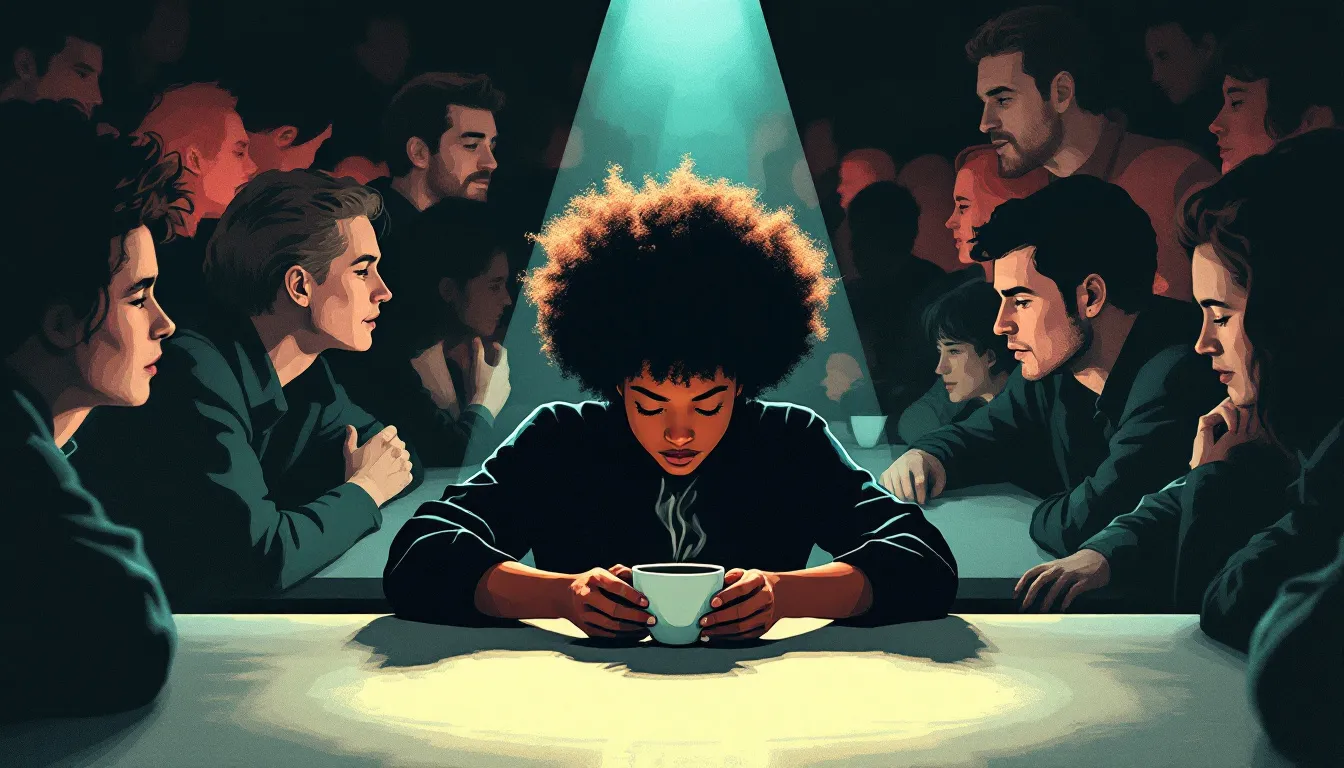
My neighbor knows my name. We wave every morning. We’ve talked about the weather, the parking situation, the new café that opened on the corner.
We have never once talked about anything that matters.
And I suspect you know exactly what I mean.
The Problem Isn’t That You’re Isolated
You probably have people around you. A partner, maybe. Friends you see sometimes. Colleagues you spend more hours with than your family. A neighborhood. A group chat that pings you seventeen times a day.
And yet.
There’s a particular kind of loneliness that doesn’t come from being alone. It comes from being with people and still not being met. You’re physically present. You show up. You contribute. You do the things that are supposed to add up to community.
But the contact is shallow. And shallow contact, repeated endlessly, doesn’t accumulate into belonging. It just accumulates into exhaustion.
The U.S. Surgeon General named this in a 2023 advisory: approximately half of American adults report experiencing loneliness. Not because they live alone in the woods. Because something about the quality of their contact with other people is missing.
We keep solving for proximity. More gatherings. More apps. More coworking spaces. More neighborly initiatives. More events.
Proximity is not the problem.
What’s Actually Missing
Here’s what I’ve come to understand: genuine community requires a shared language for what’s happening inside us.
Not vocabulary. Not NVC-speak or therapy-talk or any particular framework. Just the basic capacity to say: this is what I’m feeling, this is what I need, this is what matters to me, and have someone actually receive that. And for you to do the same for them.
Without that, you can sit in the same room every week for years and never really meet each other.
Think about the social events you’ve attended in the past year. How many times did someone ask “how are you?” and you said “fine, thanks, you?” How many conversations stayed at the level of what’s happening out there (the news, the weather, other people’s drama) and never once arrived at what’s happening in here?
That’s not community. That’s proximity. And the difference is not a small thing.
Why NVC Changes the Equation
Nonviolent Communication, developed by Marshall Rosenberg, is often described as a communication framework. Four steps. Observations, feelings, needs, requests.
But in community, NVC is something different. It’s a shared language of the interior.
When a group of people learns to name feelings without blame, to identify needs without strategy, to make requests without demand, the conversations change. Not because everyone suddenly agrees on everything. Because everyone can now say what’s actually true for them, and be understood.
Conflict doesn’t disappear in NVC communities. What disappears is the assumption that conflict means someone is wrong, bad, or an enemy. When you can hear “I’m frustrated because I need reliability” instead of “you always let everyone down,” the conflict becomes workable. Human. Something you can move through together rather than around each other forever.
Research with NVC training in Latino community programs found three themes that participants named again and again: perspective-taking, behavioral change, and “learning in community.” That last phrase is worth sitting with. The group format itself was part of what made it work. Not just the skills. The practice of being vulnerable together, over time, with shared language.
That’s the container. And the container is what creates belonging.
If you want to experience this kind of practice in community, the NVC Learning Community is where it happens.
The Difference Between a Meeting and a Moment of Real Contact
I’ve been in groups that met regularly for years and never became a community. I’ve also been in a single NVC circle where I walked in a stranger and left feeling less alone than I had in months.
The difference was contact.
Real contact is when someone sees not just what you’re saying but why it matters to you. When you feel, even for a moment, that you don’t have to perform or manage or shrink. When the conversation goes somewhere genuine because both people are willing to be honest about what’s actually happening.
This doesn’t require perfection. It doesn’t require everyone to be a trained facilitator or to speak in four-step sentences. It requires a shared commitment to staying curious about each other’s inner experience rather than just managing the surface.
NVC communities create the conditions for this because they practice it. Repeatedly. Imperfectly. With conflict and repair and moments of breakthrough.
What This Doesn’t Fix
I want to be honest about this, because dishonesty is its own kind of distance.
NVC in community is not magic. It can be misused. People can weaponize empathy language to deflect accountability. Someone can say “I’m observing that when you raise your voice, I feel scared, and I need safety” in a way that sounds like NVC and functions like a wall. The container can become a performance if people aren’t willing to do the actual inner work.
The skills matter. And the willingness to actually be changed by contact with another person matters more.
What NVC offers is a practice structure that makes depth more accessible. It lowers the cost of honesty. It gives people a way to stay in hard conversations without defaulting to attack or withdrawal. When it works, it works because people are using it to actually open, not just to say the right words.
The Thing You’re Probably Hungry For
If you’ve read this far, you’re probably not someone who needs to be convinced that something is missing in how most of us connect.
You already know. You’ve felt the difference between a conversation that went somewhere real and ten conversations that didn’t. You know what it’s like to be in a room full of people and feel invisible. And you probably have some sense that the solution isn’t more of the same.
What NVC community offers isn’t a program or an event. It’s a practice of being in a different kind of relationship with your own inner life, and then bringing that into contact with others who are doing the same thing.
The result is something that’s hard to describe before you’ve experienced it and hard to forget once you have.
You’re not seen because of what you’ve achieved or what role you play. You’re seen because someone is genuinely curious about what it’s like to be you.
That’s what belonging actually feels like.
And it’s available. Not through more events or better apps or larger gatherings.
Through a different quality of contact, practiced together, over time.
The next time you’re in a room full of people and feeling alone, you don’t need to find more people.
You need a different kind of conversation.
FAQ
Q: Why do I feel lonely even when I have people around me?
There’s a particular kind of loneliness that doesn’t come from being alone. It comes from being with people and not being met. When conversations stay at the surface (the news, the weather, what’s happening out there) and never arrive at what’s happening inside, shallow contact repeated endlessly doesn’t accumulate into belonging. It accumulates into exhaustion.
Q: What is the difference between proximity and belonging?
Proximity means being physically present with others. Belonging means being emotionally seen by them. You can have a partner, friends, colleagues, and neighbors (unlimited proximity) and still experience deep loneliness if the quality of contact stays shallow. Belonging requires that someone is genuinely curious about your inner experience, not just your external circumstances.
Q: Can NVC really help with loneliness?
Not as a solo practice, and not through skills alone. NVC’s most powerful effect on loneliness happens in community: when a group of people practices it together over time. The shared language makes it easier to say what’s actually true, to receive what someone else is feeling, and to stay in hard conversations. That’s what changes the quality of contact.
Q: What does an NVC community actually look like in practice?
An NVC community or practice group is a group of people who meet regularly to practice Nonviolent Communication together. Unlike a class or workshop, the emphasis is on the ongoing practice of being vulnerable, honest, and curious with each other, over time, with conflict and repair. The group itself becomes the container for belonging.
Sources