A moment someone shared with you
"I just have a bad habit"
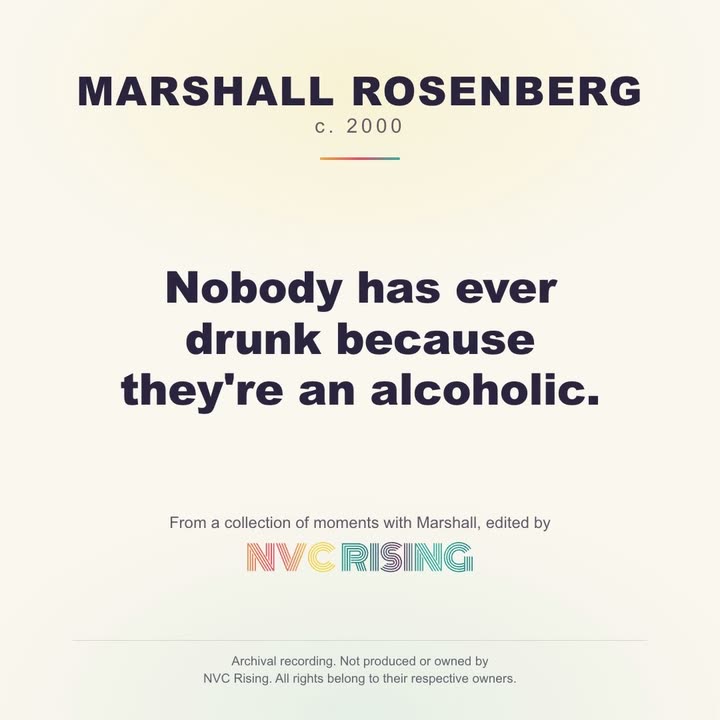
Labels like 'bad habit' or 'alcoholic' hide the real driver: a strong need, often autonomy, that the behavior is meeting.
- Marshall Rosenberg
- c. 2000
- 3:05 min
 3:05 · opens by email
A moment someone shared with you
Labels like 'bad habit' or 'alcoholic' hide the real driver: a strong need, often autonomy, that the behavior is meeting.
3:05 · opens by email Transcript
In a role-play about an employee who is always late, the employee blames 'a bad habit'. Marshall says that is a self-diagnosis: people never do anything that isn't in the service of a need. He shows the same with a drinker, then names the hidden need, autonomy, under pressure from inner and outer jackals.
If it's not meeting other needs of theirs, the need that it's meeting must be very strong. See, because people never do anything that isn't in the service of a need. So obviously even though this person has the same needs that you do for productivity, respect for other people's time, there's an even stronger need that's keeping this person from doing it. So that's empathy for that need is what you need to have. The need that is keeping this person from being on time. This person would be on time if they weren't meeting another need not to be on time. Now notice this person doesn't, isn't in touch with their need. They have a self diagnosis. And I just have a bad habit.
The rest is in the clip, subtitled.
Watch the whole clip free ↑What's inside
Search by any word Marshall says, filter by theme, or press shuffle and let a clip find you.
What is alive in us, and what we long for
Giraffe ears, presence, hearing the person behind the words
Jackal thinking, inside and out, and what lies under it
Requests, demands, honesty and a giraffe's no
Appreciation, and giving from the heart instead of duty
Couples, parents, children, exes
Mediation, war, punishment, school and social change
“You don't have to guess right, we just have to guess human.”Marshall, in “You don't have to guess right”
“Every no is a poorly expressed yes.”Marshall, in “To say no in giraffe, never say no”
“We human beings, it doesn't take much to make life wonderful.”Marshall, in “A wink across the room”
The clips are archival recordings, cut and subtitled by NVC Rising. We don't own them; all rights belong to their owners. We share them so Marshall's voice keeps reaching people.